Total Pageviews

Friday, April 1, 2011

The Notaire and Police Registration 2

In order to complete the police registration process, my lease had to be notarized.  It is not the simple, inexpensive procedure we're used to.  The notaire in Europe is a functionary of considerable significance.  For example, in France all property sales must be handled by a notaire. Notarial positions are very lucrative and often handed down from one generation to the next.  Notaires came to Croatia with the fall of communism but they sure have learned fast.  We wanted 2 duplicate originals of the lease notarized, one for me and one for my landlady to give to the tax authorities.  Instead of notarizing both of them, they notarized one for 90 kuna, then made a photocopy of it, which for some reason then cost 160 kuna to notarize.  So, for about $50 U.S. we got two notarized copies of the lease.  But they are not just any copies, they are works of art.


Armed with my copy of the lease and all the other documents I had to obtain -- proof that my landlady owns the apartment (notarized), letter of appointment from the ministry (notarized), letter of appointment from the law school (notarized), copy of my FBI criminal record check with apostille (official U.S. State Dep't certification) translated into Croatian, passport, a photocopy of the picture page of the passport and a photocopy of the address registration form -- I went to the police station this morning.  The three of us who are in Zagreb went together with Marija from the ministry.  That smoothed the way quite a bit.  She showed us how to buy the 20 kn tax stamps that are required on the application.  Then we headed upstairs where we filled out the application form.  We didn't have to take a ticket for the line at windows 29 & 30.


Instead we went to another window where we handed in all our documents plus passports, tax stamps and passport size photos, then waited to be called for our interviews upstairs.  The interview consisted of being asked to repeat the same information we had put on the application forms.  After that the woman gave me a piece of paper saying that I had applied and said we'll see you in 2 or 3 weeks when you can pick up the sticker to put in your passport at which point I will be a legal resident.  Piece of cake.  Only 2 hours and, with any luck, only one more trip to the police station.

Tuesday, March 29, 2011

Belgrade 2

I visited Ellen again in Belgrade last weekend.  Someone at the embassy had arranged for a tour of the former king's residence(s).  It is in a park-like setting on top of one of Belgrade's hills and features some spectacular vistas.

Monument to the Croats
View from the Chapel
Entrance to Main Residence


White Residence

The king apparently had to build a residence here because the palace in downtown Belgrade had become too cramped and too public.

The first words out of the guide's mouth -- "The residence was built between 1921 and 1929 with the King's private funds."


I wondered how it was that the king had "private funds."  He was a descendant of "Black George" (Karadjorje), a pig farmer who became king after he led an unsuccessful revolt against the Ottomans in 1804.  The rebellion lurched along until Milos, scion of the Obrenovic clan, actually achieved autonomy for Serbia in 1815 in the wake of the Napoleonic wars.  After that, Black George, who had been in exile, returned to Serbia. Milos had his head chopped off.  The two families feuded over the throne until 1903 when the last of the Obrenovices was thrown out of the palace windows.   By the time Alexander assumed the throne of the Kingdom of Slovenes, Croats and Serbs in 1920, the country was "poor, unstable and mostly sullen."  Where then did these "private" funds come from?  And, no wonder Alexander was assassinated in Marseilles in 1934.  Although the residence is now owned by the government, it allows Crown Prince Alexander, grandson of the builder, to live on the first floor.

The main floor of the palace is what you would expect of a royal residence.


But the really interesting part is downstairs, which the Russian architects designed to look like an orthodox church with its vaulted, highly decorated ceilings and walls.


The family obviously spent most of its time here.  There is a room with a pool table, a movie theater and one with a fountain which the king could turn on to ensure that his conversations were not overheard.


Tito (a John Wayne fan) had his own special chair in the theater room, well behind all the other seats.

In the Chapel, there is a painting of Christ on the ceiling with a bullet hole in his forehead, put there by the communists.


After the tour,  


several of us went to lunch at a restaurant located on an island where Belgradians go to boat, swim, picnic and bike. 


Friday, March 25, 2011

Worst Nightmare. Almost.

What's your worst nightmare (aside from discovering that you left your computer at the security check in Frankfort)?  How about walking out of a reststop in middle-of-nowhere Croatia and seeing your bus pull away?  Well that's what happened today on my trip to Belgrade.  I had made the trip before before.  I thought I knew the routine.  20 minutes.  The drivers smoke and eat, then get back on the bus and count heads before they leave.  So, when the drivers, who were sitting opposite me, got up to leave, I went to pay the check.  I wasn't worried that they would leave without me.  But they did.

When I saw the bus was already moving, I did my best version of running, while screaming, "WAIT!!! HEY!!!," only to watch the bus move down the entrance ramp onto the highway.  I kept walking and screaming as it merged into traffic.  Curiously, however, it appeared to be going very slowly and then it appeared to stop.  Was there hope?  At just that moment, a car pulled up beside me and the driver waved me in.  He said, "I saw what happened," and then sped to the stopped bus about a quarter of a mile down the road.  I climbed aboard, muttering "hvala (thanks)" and trying to avoid eye contact.  Disaster averted

At the next reststop after crossing the Serbian border, I waited near the bus until the drivers left the cafe.  As they approached, I pointed at the bus and said (in English) "I'm getting on."  That brought a chuckle and apparently broke the ice because a couple of women from the bus began talking to me in rapid Croatian.  I didn't understand a word of it but it sounded like, "What were you thinking back there?"  I said, "ne govorim (I don't speak)."  To which one of the women replied, "Ahh, ne govorim (stupid foreigner)."

Tuesday, March 22, 2011

A Cafe Moment

Yesterday afternoon, I stopped by Kinoteka, the cafe down the block, for a glass of wine or two.
The bar at Kinoteka
This has become my end-of-the-day routine.  Kinoteka is decorated in a style I would call "second hand store" chic.  There are random pieces of furniture of different eras, mannequins wearing antique evening gowns, red velvet drapes, marble topped cafe tables, old sewing machines.  Somehow it all works. The cafe is usually quiet and cozy in the late afternoon.  A great place to read, sip and watch -- one of the things I like most about the European lifestyle.

Yesterday something was different.  It was Monday and a band was setting up.  It turned out there were actually two bands, one featuring a blues guitar, accordian and harmonica, the other a violin.  The blues band played a few bars of "Got My Mojo Workin"" and stopped.  The violinist played part of a traditional Croatian tune and also stopped.

Pretty soon, folks started bringing in trays with pastries and other baked goods.  A table was set up in the corner, right next to me, and paper backed books were stacked on it, along with a donation box.  Votive candles were lit and put on the tables around the room.  I figured there was a fund raiser of some sort, so I asked the waitress what was up.  She shrugged her shoulders and gave me a look that said, "Sorry, but I can't explain it in English."

Then, a woman came to my table with a bag full of pastries.  She asked me if it was okay to use my table.  When I said, "sure," she began putting the pastries on small trays.  We struck up a conversation.  Her English was excellent.  Turns out she is a linguist.  Her name is Ana and she is married to a guy from New Jersey who teaches at the university.

Ana told me that the party was a wake (my word) for her friend who had died recently and had not wanted a funeral.  Marica was her oldest friend.  They had been together since high school.  Marica died after a seven month illness which had come on expectedly, and, guessing from Ana's age, far too young.  She was a writer and a translator, explaining the table of books.  The cafe was soon full.  I told Ana that, being a stranger, I felt a bit uncomfortable.  She told me to not to worry and left me with a few pastries.

I ordered another glass of wine and the bands started playing.  The lead singer of the band with the violinist wore a Mardi Gras mask.  I wasn't sure why.  The bands alternated songs and in between members of the audience read poetry.  I left after about an hour, wishing I had understood more.  But I sure hope that someone will organize something like that for me when the time comes and if a stranger drops by, they invite him to stay.

Sunday, March 20, 2011

Classes

The law faculty (Pravni Facultet) is housed in 5 different buildings around the city.  I have been in only two, both of which are on Trg (Square) Marshala Tita.

The main law faculty building

The university is huge (60,000 students), though like the law school there is no real "main" campus.  There are 6000 students in the law school, but keep in mind that law is an undergraduate subject here, as in most of Europe, and it takes them 5 years to get their degrees. I had lunch with the vice rector of the law faculty (their academic dean) this week.  She told me how European integration, through the Erasmus program, is opening up possibilities for their students to go to other universities to study for a year and vice versa.  They now have exchange programs with 94 other schools.

We've just finished the second week of classes.  My class is in the other building on Marshal Tito Square, right next door to the Cafe Hemingway (it would be to the left if it were in the photo).


There are 15 students (13women, 2 men) + 1 American Fulbright student who is sitting in because she's thinking about going to law school.  Two more from Austria are joining us this week.  Apparently, trends in university enrollment are the same here as in the states -- women are now in the majority.  The students told me that in general women predominate in the social sciences while there are still more men in the technical fields.

The students are mostly in their 5th year.  We are doubling up the classes (2x/week instead of 1) so they can finish early and study for exams.  I still can't figure out how they do scheduling here.  The days, time and room for the class were not fixed until a couple of days before it started.  There are exams scheduled throughout the year.  We're taking a week off for exams in April.  Then there is another round in June.  That said, everything else feels much the same.  Some students are well-prepared, some not.  Some participate in class, some do not.  Although there has not been the problem with class participation that I was warned about.  I think it helped that we started with a PBS documentary on the Nuremberg trials.  That jump started the conversation.  It wasn't long before I found myself trying to defend (not very successfully) the fire bombing of Dresden.  What fun!

Attendance, so far, has not been a problem either. The students told me that in most of their classes they are expected to know the contents of a long, dense textbook for the exam, yet the professors cover only a small percentage of the the book in class.  And, of course, there is no Socratic method.  So, why come to class?  I guess it made a difference that I told them that the material covered in class would be tested on the exam.

I am giving them an option of a paper or an exam.  The ones who want to write a paper came in for conferences to discuss their topics this week.  They had given their topics about as much thought as I am used to, e.g., "I'd like to write a paper about war crimes."  One of them explained the reason to me, "Here it is different because we don't tend to focus on things until there is a deadline."  My response, "What makes you think that is different."  

Tuesday, March 15, 2011

Dolac (the market)

I went to Dolac, the central market in Zagreb, Saturday before last.  You get to the market from the central square, passing through the row of flower sellers.

Then you climb the steps up to the outdoor portion of the market where they sell mostly fruits and vegetables.  I say mostly, because there are nuts, cheeses, vinegars, oils and many other things.  Despite being late February, there seemed to be no shortage of fresh produce.  Much of it comes from Dalmatia where they grow year round.  My landlady, when I told her I had been to the market, cautioned me about buying from the vendors around the perimeter.  According to her, they are Dalmatians and charge too much.  

Weighing the Produce

After buying some apples, a bundle of root vegetables for soup, and .5 liter of pungent olive oil for 40 kuna ($8), I made my way, guided by a fellow Fulbrighter who had been there before, to the back left corner of the outdoor market.  There is the entrance to the top floor of the indoor portion of the market, which is devoted to fish.  The fish is freshest on Friday because of the traditional Friday night meal.  The fish is laid out on ice. Some of it is filleted but most is just as it came from the ocean.   

The floor below concentrates on poultry and the ground floor is meat and plenty of it.  Despite the fish and poultry floors, the area around Zagreb is all about meat, especially pork and sausage.  Fish and poultry are on the menu but tend to be more expensive.  I understand fish prevails on the coast.  Can't wait to find out. 


Each of the floors also has lots of other goodies.  There are stands selling bread, wine, pastries, chocolates, olives and more.  Everything is in open containers and tasting before buy is s.o.p.  The only problem I had at the market was buying more than I could possibly consume.  Thankfully, I don't have one of those half fridges.  As far as the market goes, this sums it up for me:


Monday, March 14, 2011

Belgrade

I went to Belgrade last weekend to visit Ellen Kelly, who has lived there while working for USAID for the last 7+ years.  The trip by bus from Zagreb takes 5+ hours on a dye straight road through incredibly flat country.  The trip includes a couple of rest stops and about 20 minutes to get through the border crossing.  

I don't know what I expected to find Belgrade (some sinister place that wreaked of evil where the people have horns) but it wasn't what I found.  It is a city with wide boulevards, some impressive architecture, and all the name brand shops you'll find in any western capital.  There is a vibrant street scene with a large pedestrian shopping area jammed with the cafes that seem to be ubiquitous in this part of the world.  Spurred on by the gorgeous weather, people were out in droves.


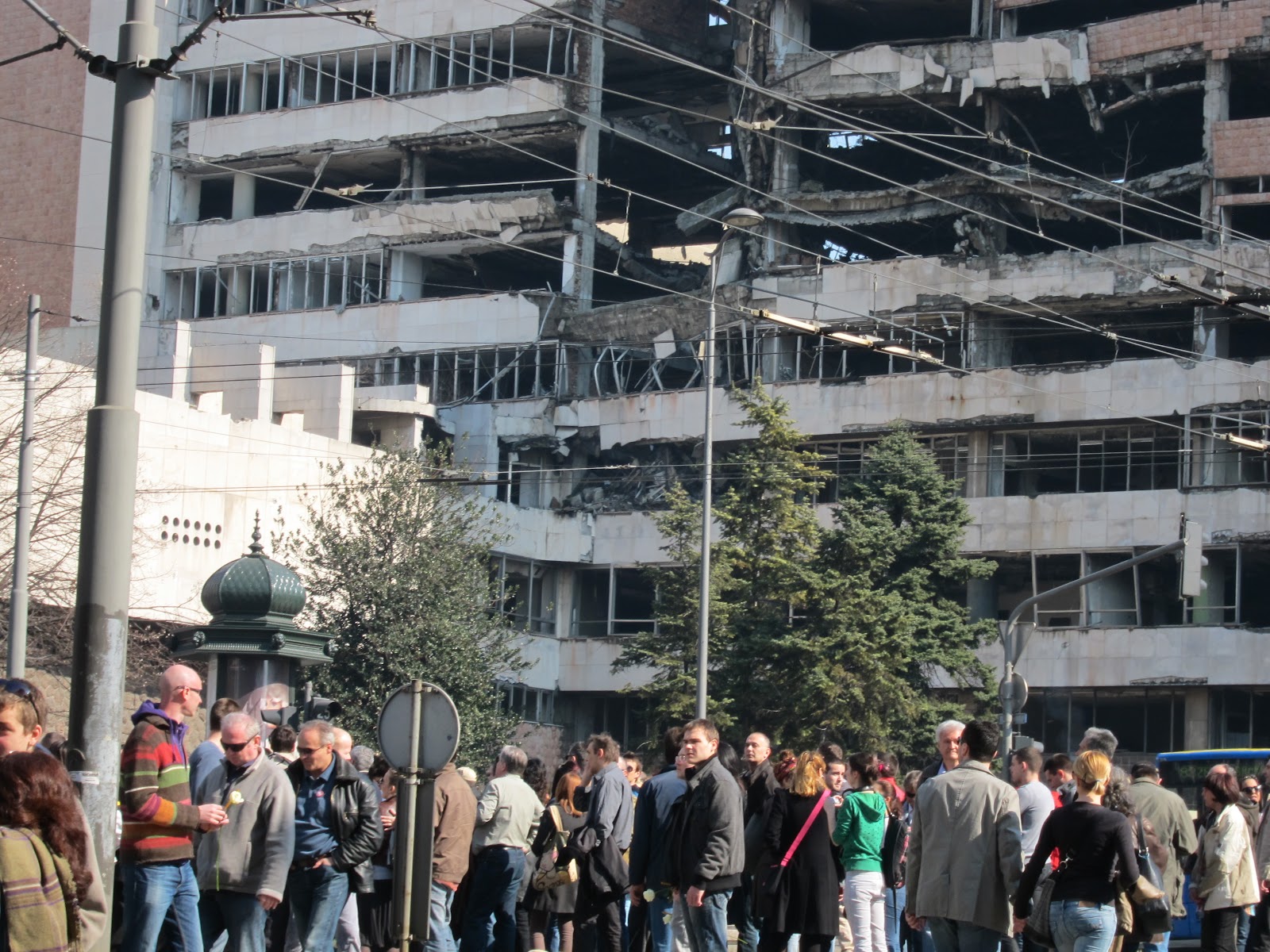
As we headed toward lunch on Saturday, we found ourselves in the middle of a large demonstration honoring the anniversary of the assassination of the reformist, pro-western prime minister, Zoran Dindic (pronounced Zindzich), in front of the building where it took place.


Right across the street were the remnants of the defense ministry building bombed during the "1999 NATO Aggression against the Federal Republic of Yugoslavia."  This was how it was described in the Serbian war museum which we visited after lunch.


Lunch was in pleasant outdoor cafe.  Lunch and all the food I had in Belgrade was terrific, one of the pleasant surprises.  If you ever get there you must eat at the Iguana, a restaurant on the docks that line the Sava River.  It is owned by Ellen's friend and it is a real find.  After lunch, we wandered through the large park surrounding the Belgrade fort in which the war museum is located.  It is a spectacular setting overlooking the confluence of the Sava and Danube rivers.


One cannot spend any time in this region without trying to eff the ineffable -- why did the war happen?  Volumes have been written about it.  But on the bus going home, I read something that struck a cord. Rick Steves relates this "old joke" -- "Yugoslavia had eight distinct peoples in six republics, with five languages, three religions and two alphabets, but only one Yugslav -- Tito."